
How to Find the Best Studio in Lahore for Podcasts, Photos & Videos

If you're looking for a studio in Lahore that can handle podcasts, photos, and video without booking three separate vendors, the real question is whether that's actually the right approach for your specific content needs, or whether specialization matters more than convenience in your case. Both answers can be correct depending on what you're producing.
This guide breaks down how to actually evaluate a multi-purpose studio versus specialized ones, what compromises come with an all-in-one setup, and how to match the right studio type to your content plan without wasting a booking on the wrong fit.
When a Multi-Purpose Studio Makes Sense
Creators and brands producing multiple content types regularly benefit most from a single studio relationship, mainly through reduced logistics and consistent quality across formats.
If you're running a YouTube channel that includes talking-head video, occasional product shots for merch, and a companion podcast, coordinating one studio relationship saves real time compared to managing separate bookings, briefings, and file-transfer processes with three different vendors. It also means your brand's visual and audio identity stays consistent, since the same team understands your lighting preferences, mic setup, and editing style across formats.
Example scenario: A founder running both a business podcast and occasional YouTube explainer videos found that using one studio for both meant the team already knew their preferred lighting temperature and mic gain settings from prior sessions, cutting setup time by roughly 10-15 minutes compared to briefing a new studio each time. This consistency also meant their podcast audio and video content shared a recognizable visual look across platforms.
When Specialized Studios Make More Sense
A multi-purpose studio isn't automatically the better choice, and it's worth being honest about where specialization wins.
If your primary need is highly specific, a fashion brand needing extensive apparel photography with a large model-ready space, or a podcast that needs a dedicated multi-camera broadcast setup, a studio specialized in exactly that format may have deeper equipment investment and more focused experience than a general-purpose space splitting its resources across formats.
Example scenario: A fashion brand shooting a large seasonal lookbook found that a dedicated fashion photography studio, with a bigger open floor plan, multiple backdrop colors, and a proper garment steaming setup, served their shoot better than a general content studio whose photo area was sized primarily for product tabletop shots rather than full-body model work.
Your Situation | Better Fit | Why |
Mixed content: podcast + occasional video/photo | Multi-purpose studio | Consistency and convenience across formats outweigh specialization |
Heavy, recurring fashion/apparel photography | Specialized photo studio | Larger space and dedicated equipment for model-based shoots |
Multi-camera broadcast-style podcast | Studio with dedicated multi-cam podcast setup | Deeper investment in switching and sync equipment |
One-off single format need | Whichever studio fits that specific format best | No ongoing relationship benefit to weigh against fit |
What to Actually Check Before Booking a Multi-Format Studio
Not every studio advertising multiple services delivers equal quality across all of them, and it's worth verifying rather than assuming.
Ask to see recent portfolio work in each specific format you need, not just their strongest category. A studio might have excellent podcast production but a photo area that's clearly an afterthought, with limited backdrop options or lighting equipment shared awkwardly between departments. Ask directly how their space and equipment are allocated between formats, since a studio with one flexible room serving all purposes handles bookings differently than one with genuinely separate dedicated spaces.
Example scenario: A brand contacted a studio advertising "podcast, photo, and video" services, only to discover during a site visit that the photo area was a small corner with a portable backdrop stand, clearly secondary to their main podcast room. For a quick headshot, that setup was fine. For their planned 20-product catalog shoot, it wasn't, and they booked a dedicated photo studio instead for that specific need.
Questions That Reveal Whether a Studio Is Genuinely Multi-Capable
A few direct questions during your initial inquiry tell you more than their marketing materials will.
Ask whether each format, podcast, photo, video, has its own dedicated space or shares one flexible room, since shared spaces mean longer changeover time between different content types if you're booking a combined session. Ask about equipment specifics for your format rather than accepting a general "yes we do that," since a studio might technically offer video production with just one camera and basic lighting, which won't suit a multi-camera talking-head YouTube setup.
Example scenario: A creator planning a combined session, recording a podcast episode and then shooting single-camera YouTube B-roll footage in the same visit, confirmed beforehand that the studio's podcast room could be quickly reconfigured for video without a full room change. This saved a separate booking and roughly 45 minutes of travel and setup time compared to using two different studios for the two formats.
Checklist for Choosing the Right Studio Type for Your Content
Use this before deciding between a multi-purpose or specialized studio:
List every content format you'll realistically need over the next six months, not just your current project.
If mixed formats are occasional, weigh convenience of one studio relationship against any specialization trade-off.
If one format is heavy and recurring, like extensive fashion photography, prioritize a studio specialized in that format.
Ask to see portfolio work specifically in each format you need, not just the studio's strongest category.
Confirm whether formats share one flexible space or have dedicated areas, since this affects changeover time for combined sessions.
Get format-specific equipment details rather than accepting a general "yes we offer that" answer.

Where This Fits at Delenzo Studio
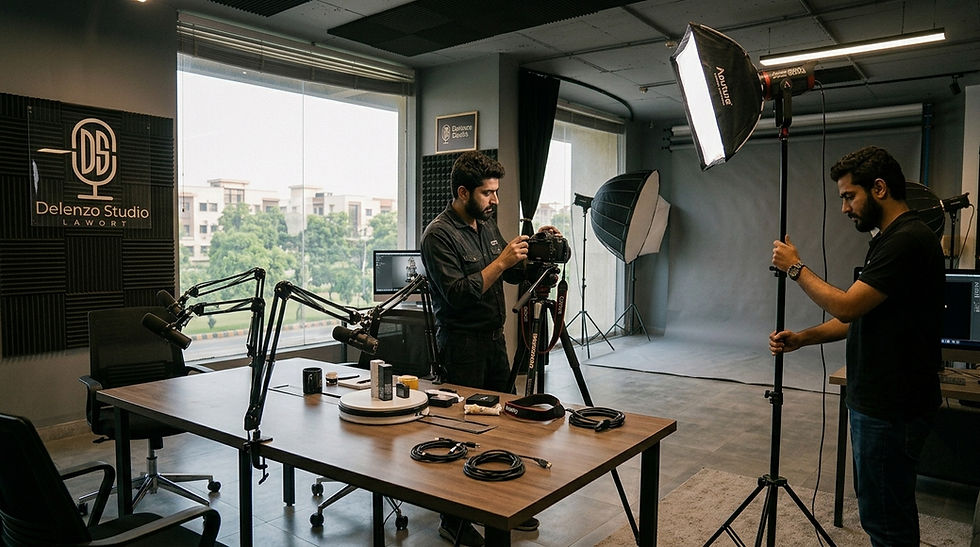
If you're weighing a multi-purpose studio for your mixed content needs, Delenzo Studio in Gulberg V, Lahore runs dedicated podcast, photo, and video setups within one facility, with each area equipped specifically for its format rather than shared generically. Book a session via WhatsApp at +92 325 1111082 or visit delenzostudio.com.pk.
Choosing between a multi-purpose and a specialized studio comes down to how your content mix actually looks over time, not just what's convenient for one booking. If your formats are varied but occasional, one studio relationship likely serves you well. If one format dominates your output, a studio built specifically for that will usually outperform a generalist space. Either way, ask for format-specific proof before you book, not just a general capability claim.
FAQs
Is it better to use one studio for podcasts, photos, and video, or separate specialized studios? It depends on your content mix. If you produce varied but occasional content across formats, one multi-purpose studio saves time and keeps your brand consistent. If one format, like extensive fashion photography, dominates your output, a specialized studio usually has deeper equipment and experience for that specific need.
How do I know if a multi-purpose studio is actually good at all its services? Ask to see recent portfolio work specifically in each format you need, not just their strongest category. A site visit also helps, since it reveals whether each format has genuinely dedicated space and equipment or is treated as a secondary offering.
Do multi-format studios take longer to set up for combined sessions? It depends on whether the studio has dedicated spaces per format or one flexible room serving all purposes. Ask directly how reconfiguration works between formats if you're planning a combined session, like a podcast recording followed by video B-roll.
What questions should I ask before booking a studio that offers multiple services? Ask about dedicated equipment and space for your specific format, not just a general yes-or-no on whether they offer it. Also confirm changeover time if you're booking a combined session across multiple content types.
Is a multi-purpose studio cheaper than booking separate specialized studios? Not necessarily cheaper per session, but it often saves time and logistics costs across multiple bookings, since briefing, file transfer, and travel happen once instead of repeatedly. For heavy, format-specific needs, a specialized studio may still be worth any added logistics cost.


Comments